
Who Makes It Happen: Emily Brannan
Updated: Feb 19
Foundry Lead, Head Mount-Maker, and Gutsy Artiste
This is the first in our series shouting out the people behind Denali's work – the fabricators, installers, mount-makers, and problem-solvers who make all your wildest art dreams come true.
Emily Brannan casts bronze, bends brass, and doesn't ask permission to solve problems her own way.
She's Denali's foundry lead and head mount-maker – the person who figures out how to support ancient ceramic vessels without touching them, cast a 14-foot bronze sculpture in sections, or fabricate mounts when an exhibition install can't wait. Torch in hand, Amyl and the Sniffers on the playlist, ready for whatever comes next.
I'm not looking for a fight, but I'm ready if you are. (We think this might just be the perfect lyric to sum up how Emily works.)

From Ohio to New Orleans
Emily earned her BFA in Studio Art with a concentration in Sculpture and a minor in Metalsmithing from the University of Akron in 2018. She spent years working for jeweler and sculptor Sherry Simms-Vucenovic, learning precision work on a small scale - soldering, metal forming, the kind of detail work where a millimeter matters.
"I made a lot of jewelry for [Sherry]," Emily says. "She's a jeweler and a sculptor - jewelry is kind of tangential to her sculptural practice."
That training taught her how metals behave, how joints hold, how to make something structurally sound and aesthetically clean at the same time. She also did metal forming – hammering flat sheets into three-dimensional shapes, soldering halves together to create solid pieces. Die forming, specifically. You take a silhouette, cut it out of two pieces of wood, place your copper sheet between them, and hammer following that shape to whatever depth you want. Flip the mold, do the other half, solder them together – suddenly you've got a solid sculptural object from flat material.
If Emily could teach someone one skill, it would be soldering. "I think soldering is a very versatile skill. You can do a lot of things with it. You can make jewelry with it. You can make all kinds of crazy sculptures. The possibilities are pretty broad."
There's something deeper there too – something about the connection to working with metal that goes beyond technique. "Metalworking – you can make so much cool stuff out of it and it lasts forever. We've been doing this for thousands of years and there's something like intergenerational muscle memory. I think we all have that. People get too in their head about stuff, but it's really an accessible thing. Once you start to do it, you're kind of like, okay, yeah, yeah, yeah."
That confidence – that sense that humans have been shaping metal for millennia and you can tap into that same intuitive knowledge – shows up in how Emily approaches problems at Denali. Metal isn't intimidating to her. It's a material with history, with memory, with possibilities.
As studio assistant in the metalsmithing and sculpture studios at Akron, she got hands-on with large-scale bronze casting. "When we did bronze casting in the sculpture studio, it usually happened over Thanksgiving break. I was still in town and in charge of making sure everything was burnt out properly, pulling wax from the bottom of the kiln, reshuffling things in the shop to open up the sand pit for casting."
After earning her MFA in Sculpture at SUNY New Paltz in 2021, Emily worked at the Ohr-O'Keefe Museum in Biloxi. Smaller institutions mean wearing many hats. When the museum received wooden figures that couldn't stand on their own, the director asked Emily to make armatures.
"Those were my first mounts. Very simple steel wire T-supports that I soldered. It was a lot of trial and error, but I loved it."
She joined Denali in 2022, initially for foundry work. When the previous mount-maker moved on, Emily's metalworking background made the transition natural.

The Dunbar Project: Baptism by Bronze
Emily's first project at Denali was George Dunbar's Monumental Deity XX bronze sculpture for Poydras Street.
"It was a giant wax piece hanging up in this room, and there was a lot of wax work left to be done."
The project ran from late 2022 through summer 2023. Dunbar came to the shop for meetings, giving adjustments and approval. The casting process itself was steep. "It was the largest piece I've ever cast. I think it's the largest piece Dan's ever cast."

The team initially tried casting in larger sections, which didn't work. "When you have big pieces like that, you need steel armatures and chicken wire reinforcement all around it. We didn't have any of that."
Emily had never used ceramic shell casting before. She was learning in real time alongside Abe Geasland and Thor Carlson. "Once we hit something that worked, it went at a decent pace."
The piece was completed just in time. Dunbar came to the shop, approved the final sculpture. Two days later, he passed away, before seeing it installed on Poydras Street.

What Goes Down at Emily's Workbench
Beyond foundry work, Emily handles mount-making for museums, galleries, and private collections – creating the invisible supports that hold objects safely without being seen.
She's worked on everything from ancient ceramics at Tulane's Middle American Research Institute to a high-profile installation at the Fontainebleau Las Vegas. (That job involved soldering last-minute mounts on top of a rolling toolbox in the back room. You could say resourcefulness is part of the Denali job description.)
Her work also includes sculpture refurbishment and repair. She's hot-waxed some of the most iconic bronzes in Nola, including the piece locals call "Swimmer Girl" in the French Market. She's fabricated custom hardware for the Historic New Orleans Collection. And she shows up on museum install jobs across the country, handling everything from delicate artifact mounting to rigging large-scale contemporary work.

The range is wide, but the standard stays consistent: museum-quality care, whether the work is going into a major institution or a private collection.
Earlier this year, she presented at the New England Museum Association (NEMA) conference on a panel about mounting unusual objects – things that require creative problem-solving rather than standard approaches. "Making connections with other museum professionals was invaluable," she reflected afterward. "Understanding the full development of an exhibition is always helpful, even when mount-making comes in as one of the final steps."

Maintaining a Creative Practice (While Making Work for Other Artists)
Like many of the Denali crew, Emily is first and foremost an artist in her own right. As a sculptor and installation artist who works primarily in fiber and textiles, exploring themes of trauma and healing, her installations incorporate hair, fabric, and sculptural elements.

She's honest about the challenges of maintaining a personal practice while working full-time in fabrication. "It's kind of hard because you spend all day making work for other people. You get home and you just don't wanna think like that anymore. All the problem-solving is expended at work."
Still, the collaborative environment at Denali keeps her inspired. "A lot of my peers here are also creative people, so it's inspiring to talk about what their ideas are or what they're working on. And also, getting familiar with new materials that maybe I wouldn't find on my own is always helpful too."

There's also the practical benefit of working in a well-equipped shop. "If we're making a mold and we've mixed up too much silicone, and there's a little bit left in the bucket and I've got a little tiny thing I wanna make a mold of, then I can make a little mold. So that's always fun. That's a little bit exciting, right? Changes the course of things too, because then you end up making a mold of whatever's laying around and suddenly that's maybe a part of what you're working on."
She's also picked up woodworking skills since joining Denali – not just carving, but actual construction. "All the woodworking that I've done in the past has just been carving. Not actually building boxes or things that need to be geometrically perfect and square. So it's also good to just have those sensibilities or be familiar with that."

If Emily Could Collaborate With Any Artist...
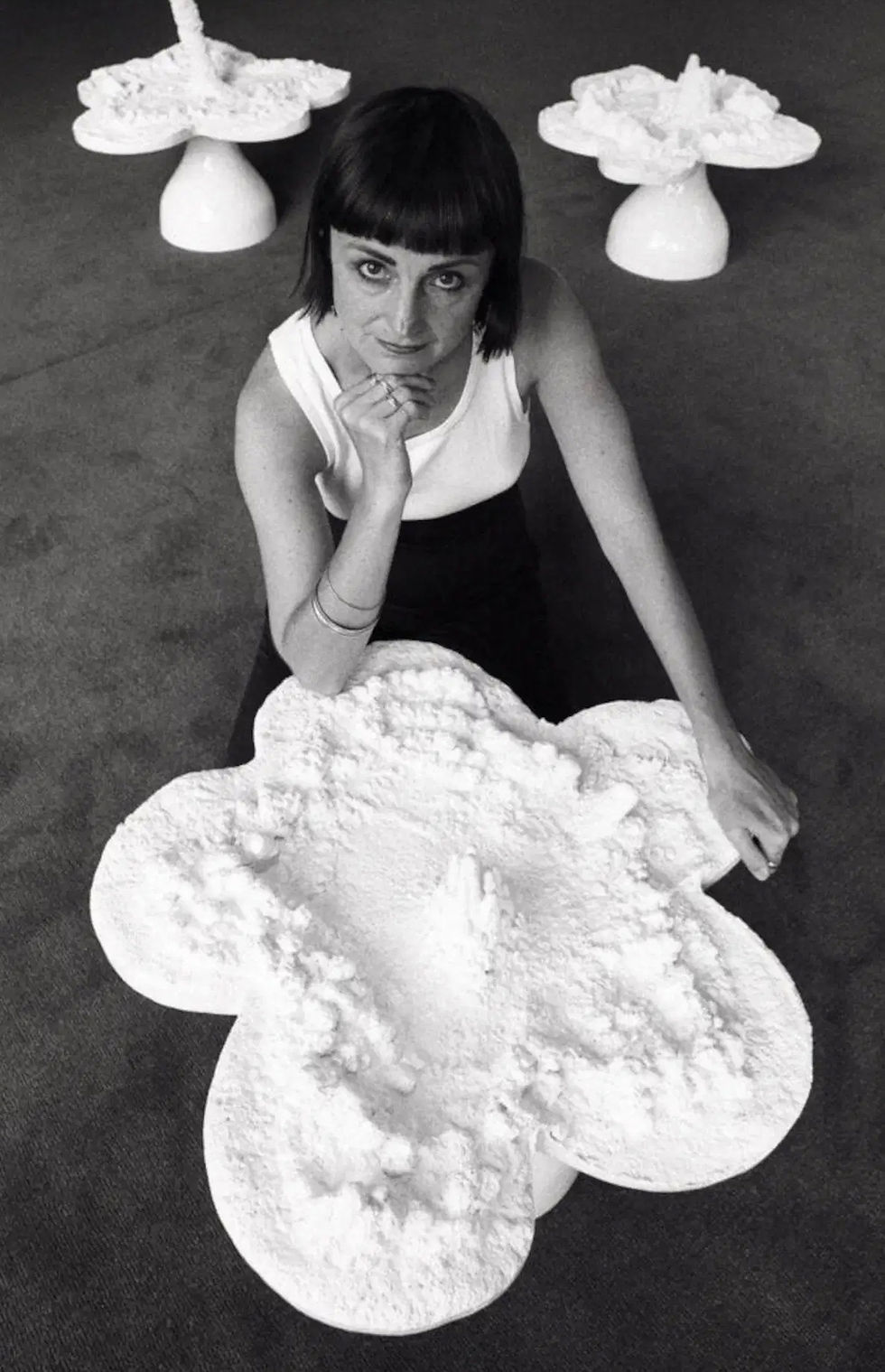
Helen Chadwick. No question.
"I just really appreciate a lot of her work conceptually. Piss Flowers is one of my favorite art pieces conceptually. Her process in making those pieces and peeing in the snow and then flipping, talking about gender roles and the phallus – I think it's super interesting. I just like the way she thinks, so I think we could make something very interesting if we were working together."
A very important side note: Emily and Helen Chadwick share a Taurus birthday, just a few days apart – May 14th to Chadwick's May 18th. Taurus twins!
That conceptual thinking, combined with serious technical chops, is what makes Emily's approach distinctive. She understands materials deeply – how they behave under stress, what they can hold, how to make something that's both structurally sound and aesthetically resolved. Emily's pretty rad - just like Helen - if we do say so ourselves.
What Emily Likes Most About Denali?
"The people. Hands down."
"Everyone actually supports each other. You can argue with someone, get frustrated, and then be laughing together 30 minutes later. There's never any lingering weirdness."
She appreciates something less tangible about working with people who build things by hand. "I think if you build things, somehow that translates to you having better interpersonal relationships because you just have a better understanding of mechanics and how things work in a general sense."
There's also the camaraderie from working through physical challenges together.

For instance, getting a 500-pound crate onto a truck at an angle with four people requires real communication. "Those kinds of tasks seem simple, but they can be stressful and challenging. You really have to understand who you're working with."
She's also observed something about the difference between office work and hands-on fabrication. "I think it's great that we all can support each other here in such a good way and have a real understanding of the world in a practical sense."
"Something about having a job where you have to construct things and put things together – that's the work you're doing. It translates somehow to you having better interpersonal relationships because you just have a better understanding of mechanics and how things work in a general sense."
Grateful for Good People
Emily's work at Denali might not always be visible – mounts are meant to disappear, foundry work happens behind the scenes – but it's essential to nearly every project we take on. Pouring bronze for a monumental sculpture. Bending brass wire to support ancient ceramics. Refurbishing public art in the Louisiana heat. Emily brings precision, adaptability, and deep respect to all of it.
"I'm really grateful for the opportunity to work at Denali and work with the people that I work with. Everybody gets along so well and makes a conscious effort to support each other no matter what. It's good to work with good people who are so talented and know their shit. They're just good people."
And if you find yourself in Lake Charles this spring, go check out some of Emily's artwork at DPR Gallery – she's exhibiting in a group show entitled object/object for Milieu Art Platform, February 28 - May 16. Go support our gal!

Got a project brewing that could use a healthy dose of Emily's know-how? Get in touch.
Learn more about Emily's mount-making process in our deep dive on custom fabrication.
This post is part of our Shop Talk series, where we pull back the curtain on how art fabrication and installation actually work. Want more insights like this delivered to your inbox? Join our mailing list.


Comments