
Project Spotlight: jackie sumell's Endangered Feces
Fabricating Decomposable Sculptures for Rice University's Moody Center
Sculpting endangered species scat wasn't on our project list when 2025 started, but here we are.
When you work with artists who have limitless imaginations, you learn to expect the extraordinary. Still, when artist jackie sumell came to us about Endangered Feces – a commissioned installation for Rice University's Moody Center – we knew this one was going to be different.
jackie needed custom molds capable of holding over 200 pounds of Revolutionary Mortar (a mixture of dirt, natural hydraulic lime, and organic materials), but light enough to be moved and manipulated by hand during a collaborative building process. The molds would form decomposable sculptures shaped like the scat of two endangered Gulf Coast species: the Houston Toad and the Attwater's Prairie Chicken. Once installed, these sculptures would gradually break down and revitalize the Harris Gully landscape, contributing seeds from native endangered plants back into the soil.
Conceptually brilliant. Fabrication-wise? A whole new challenge.

How a (Poop) Project Takes Shape
Emily Brannan, our foundry lead, made an early visit to jackie's studio to work through the logistics. This wasn't the kind of project where you can quote from photos and specs alone – understanding jackie's vision from the ground up was essential.
jackie worked with artist Ursa Eyer to create styrofoam positives based on her research into the scat shapes of these endangered species, scaled to the size she wanted for the final sculptures. Our job was to engineer molds that could withstand intense physical force during the packing process (think: repeated tamping of heavy mortar mixture) while remaining portable enough for a collaborative installation involving Rice students, faculty, and volunteers.
That studio visit set the tone. When the concept is this unusual and the execution this specific, early collaboration isn't just helpful – it's how you avoid expensive mistakes down the line.
Making It Roll: The Fabrication Challenge
Emily and Charlie headed up the fabrication, working with a material combination we'd never tackled quite this way: fiberglass and resin for the mold shells, reinforced with custom-welded steel frames.
But here's where it got interesting. These molds needed to take a beating – literally. They'd be packed with Revolutionary Mortar using small hand tamps, which means they had to be tough. But once filled, each mold would weigh around 200 pounds. Moving something that heavy typically requires lifting equipment, multiple people, or both. Not exactly conducive to a collaborative community build.
Dan came up with the solution: build the molds so they can roll.
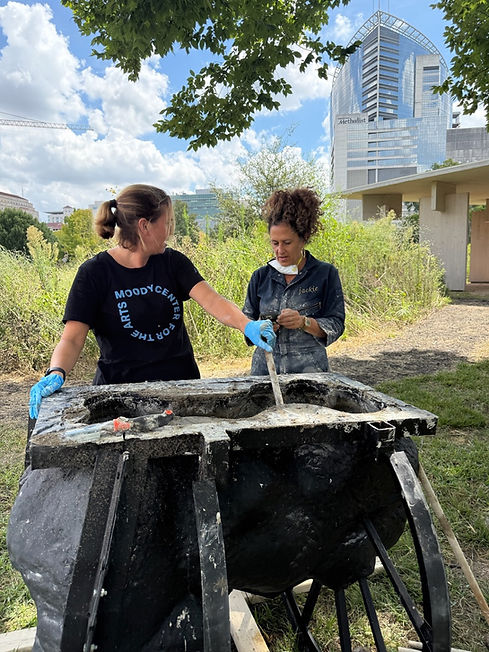
He designed steel roll cages that allowed the filled molds to be tipped onto their sides and rolled to their final positions. The open side of each mold pulled double duty – it's where the material got packed in, and when you opened the mold, that same side rested on the ground, letting the sculpture settle into place without needing a crane or a forklift.
Simple concept. Not simple to execute.


Problem-Solving at 100-Degrees
Emily and Charlie were fabricating in the middle of a Louisiana summer – 100-degree heat, humidity you could swim through, and resin that set up fast. Too fast, sometimes. The resin would heat up as it cured, occasionally melting the styrofoam positives or even the work surface underneath. They had to move quickly, adjust their approach on the fly, and troubleshoot in real time.
"We were cutting ourselves, getting covered in resin and fiberglass," Emily said. "It was awful. The resin would melt the table, melt the styrofoam. By the time we finished the second mold, we'd figured out the right way to do it. And then it was done."
Classic fabrication learning curve – you figure it out as you go, and by the time you've perfected the method, the project's finished. At least now we know exactly how to build decomposable scat molds if anyone else comes calling.
In jackie's Words
jackie, who's spent most of her career fabricating her own work, had this to say about the collaboration:
"It was a rare and meaningful shift to collaborate with a team that is not only exceptionally skilled, but also careful, thoughtful, and deeply invested in the work. The balance Denali brings between creative openness and technical expertise felt like working within a fully realized production artist's studio.
What made the experience distinct was the way your team helped translate that vision into something possible. Emily's visit to my studio to work through logistics created an early sense of trust and momentum. That was followed by deeper exchanges with Dan and multiple visits to your shop, which further clarified the direction and expanded what felt achievable.
There were a few technical challenges that required problem-solving along the way – those adjustments strengthened the final outcome and made the work better than I originally imagined or designed.
I love the balance of play and imagination, paired with a punk, 'anything is possible' energy and competence. That spirit made the collaboration feel alive, generous, and creatively expansive."

Revolutionary Mortar:
More Than Just a Mixture
Once the molds were complete, the collaborative build began. Rice students, faculty, and volunteers worked alongside jackie to pack the Revolutionary Mortar mixture into the molds, forming sculptures shaped like the scat of the Houston Toad and the Attwater's Prairie Chicken – two endangered species facing serious decline due to habitat loss and climate change.
The Revolutionary Mortar mixture itself carries layers of meaning. jackie developed this material in 2015 for Solitary Gardens, the first phase of this ongoing body of work. The mixture – non-hydraulic lime, river sand, and organic materials – threads connections between crops grown during chattel slavery and plant matter from the diets of endangered animals. In Solitary Gardens, this mortar formed garden beds recreating the footprint of 6x9 solitary confinement cells, disrupting the isolation of prison and reconnecting incarcerated people with the natural world through collaborative gardening with volunteers.
Endangered Feces extends that work into a different context but with the same foundational materials and ethos. The sculptures now rest in the Harris Gully area on Rice's campus, where they'll gradually decompose and release seeds from geo-specific native endangered plants back into the landscape. As jackie describes it, these are "durational sculptures" – pieces designed to break down over time with intention and education.

Art as Intervention
This isn't art as representation. It's art as intervention – connecting the disposability of endangered species with the disposability of incarcerated people, highlighting the shared vulnerability we all face in the climate crisis if we don't move toward collective action. The sculptures don't just symbolize ecological restoration – they perform it, literally reseeding the landscape while asking viewers to reconsider what we value, what we discard, and what we're willing to protect.
Conservation organizations like the Houston Zoo and the Attwater Prairie Chicken National Wildlife Refuge are working to protect these endangered species. jackie's project brings that urgency into public space while weaving it into larger conversations about mass incarceration, environmental justice, and our collective responsibility to the land and to each other.
Operating as both metaphor and praxis, Endangered Feces asks us to shift harmful practices toward a foundation of stewardship. Or as jackie might put it: stewardshit.

Why We Do This Kind of Work
For us, this project pushed us into territory we'd never navigated before – large-scale molds with unusual structural requirements, material combinations that demanded quick thinking in brutal heat, and a collaborative installation process supporting a conceptually layered artwork with roots in prison abolition and ecological justice. We got covered in resin, melted some styrofoam, learned a lot about endangered species scat shapes, and came out the other side with two functional molds that made jackie's vision possible.
When jackie says the collaboration "made the work better than I originally imagined," that's exactly why we do this kind of work. Not just executing what's on paper, but figuring out the solutions that elevate the final piece – even when the final piece happens to be sculptural poop with a serious purpose.
Got a project that needs some unconventional thinking? We're here for it.