
How to Create Public Art: A Real-World Guide
Being an artist isn't easy. There are creative challenges, financial pressures, and the constant work of making your vision real. Being an artist who wants to create public sculpture? That adds layers of complexity most people never see – engineering requirements, municipal regulations, site specifications, timeline constraints that stretch for years.
There's less creative freedom in some ways. Your vision has to meet safety codes, weather extreme conditions, and satisfy multiple stakeholders. But here's what we've learned after dozens of public art projects: when you collaborate with a fabrication team who are artists themselves, who understand the creative process because they live it, the whole thing becomes less daunting. We've built everything from 14-foot steel structures that started as paper maquettes to monumental bronze castings. We know the regulations, we know the surprises, and we know how to help you navigate it all without losing what makes your work yours.
Everything you're about to read comes from projects we've actually built. We'll walk through the steps, the decisions you'll need to make, and the challenges you'll face along the way.
Yes, this is a long one – there's a lot to cover when it comes to making public art.
Start With Engineering
"The number one thing is, get a stamped engineering drawing of your sculpture drawn out," Dan says during shop tours.
This feels backward to a lot of artists. You want to start making, not drawing up technical specifications. But here's why it matters: the stamped drawing ensures that what you're going to spend money fabricating is actually structurally sound, safe, and buildable the way you envision it. You don't want to get a stamped drawing made after fabrication has already started, because you could wind up having to make expensive changes.
What a Stamped Drawing Actually Is
An engineering drawing shows exactly what materials you're using, the size of everything, and how it all goes together. Then an engineer reviews it, runs calculations, and stamps it with their seal.
With public art, liability is real. As an artist and/or the fabricator, you don’t want to be held responsible if something goes wrong. An engineer can tell you what you need to take every precaution. "If something can fall over and hurt someone, you need an engineer," Dan explains.
The cost of a stamped drawing ranges from around $800 to $1,500, depending on complexity.
The Wind Rating Letter
Down in the Gulf South (and in many coastal areas), you'll also need a wind rating letter. This is a document certifying that your sculpture can withstand the wind loads for your specific location. Engineers run calculations through specialized software to determine whether your piece meets the requirements for wind load ratings – and if it won't, what modifications are needed to make it safe.
Getting this done properly gives you plausible deniability if something goes wrong. Gulf Coast weather is serious. While a wind rating letter doesn't guarantee your sculpture will never sustain damage, it shows you took the proper steps to engineer it correctly. Without it, you're exposed to significantly more liability if the piece fails.
The Budget Problem
Here's where it gets tricky. Many public art programs work like this: artists apply with a budget, get selected, then find out the engineering requires thicker material, which skyrockets the overall cost.
If you're writing a proposal with a fixed budget, talk through possible budget shifts with your fabricator before you submit. "I'll quote what's needed to make the piece so it fits the proposal, so the artist knows they're working within the budget, and then we find out the material thickness has to double to make it structurally safe, and it blows the budget out of the water," Dan notes. "So what do you do? Do you make the sculpture smaller? Do you change the material entirely? It can be frustrating."
His advice: "You want to have the money in hand for the proposal before you go to the engineer, but you have to let the engineer know what you're going for. So it becomes a bit of a balancing act. Most public calls have some degree of leniency about design changes after an award is given, so clarifying the expectations and having a plan B can be helpful."
On one New Orleans East project, the engineer required three-eighths material instead of the quarter-inch Dan had planned for. "My material budget went from $40,000 to $65,000. Stainless steel is very expensive." The arts agency found additional funding, but that doesn't always happen.
Shop Drawings: Translating Vision into Buildable Plans
Between your initial concept and the final fabricated piece, there's a crucial step that many artists don't anticipate: shop drawings. These aren't the same as your artistic renderings or even your engineering drawings – they're detailed technical documents that tell fabricators exactly how to build your piece.
"You're trying to give someone as much information as you can about the thing they have to make, so they minimize their decision-making," explains Eric Lynn from Workhaus, who creates shop drawings for Denali's public art projects. "It's giving them the right dimensions, the right types of finishes, the right types of material thicknesses, and thinking through: if this thing goes to point A, how does it affect B? How does it affect C?"
Shop drawings can take different forms depending on the project:
Sketches with dimensions: For simpler projects, quick sketches with measurements might be all that's needed. "That's kind of how it goes 75 percent of the time," Eric notes.
Formal shop drawings: More complex projects require detailed two-dimensional drawings showing every component, how parts fit together, and all specifications. These drawings go to outside fabricators, engineers, or the city for approval.
3D digital models: For complicated sculptures, Eric creates three-dimensional digital models. "We can start to zoom around it and pick views and be like, oh, does this thing look right? Do we need to tweak this? Do we need to change these dimensions?" This helps everyone – artist, fabricator, engineer – see potential issues before any metal gets cut.
Renderings: When you need to show what the finished piece will look like on site, renderings add color, materials, and context.
For Matt Scobey's Poydras Corridor Polyhedra, formal shop drawings were essential – the geometric precision required detailed specifications that everyone could reference. For other projects, like Grace Boyle's most recent work, Fat Tuesday Flirt, the process is more flexible. "There was an amount of flexibility, there was definitely a vision, but as long as we make the framework, everything else kind of comes together," Eric says.
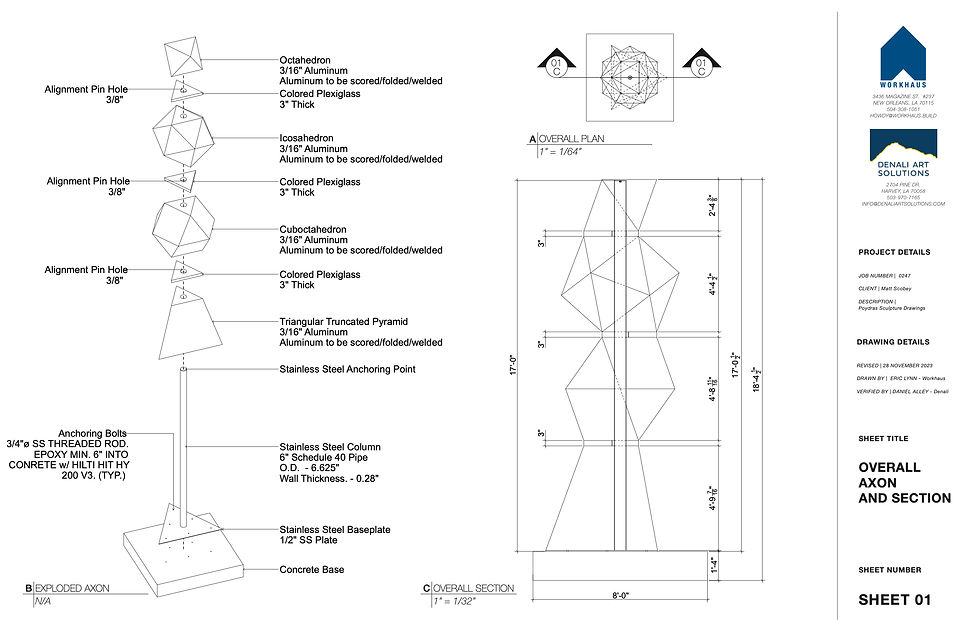
The key is understanding that shop drawings are a communication tool that ensures your artistic vision translates accurately through engineering requirements to the fabrication shop. Even three-dimensional sculptures are built from two-dimensional components that need to be precisely specified.
Missing or unclear shop drawings lead to fabricators making their best guesses about what you want – and those guesses might not match your vision. Good shop drawings eliminate ambiguity while still allowing for the craft expertise that happens in the shop.
Material Choices Matter (A Lot!)
Aluminum vs. Steel
"I highly recommend aluminum sculptures with powder-coated surfaces," Dan shares. "It's the best thing you're going to be able to find to hold up to the weather down here."
Why aluminum?
Lighter (easier to transport, easier to install)
Easier to grind
Doesn't rust (though it will oxidize over time, so clear-coats are recommended)
Note: Steel is actually easier for most shops to weld than aluminum, so if you have a welder who specializes in aluminum (like we do), that's a real advantage. Stainless steel also shares aluminum's corrosion-resistant properties and is stronger, but it's pricey.
"Even though the material costs a lot more than steel, it's just so much easier to deal with," Dan explains. "The money I would save from fabrication would gladly pay for the difference in material costs."
Steel works fine if you're going for a raw, weathered look with Cor-Ten (which rusts to a stable patina and then stops). Otherwise, you're looking at constant maintenance.
Bronze Casting
Bronze is beautiful, permanent, and expensive. Really expensive.
"Bronze is often around the $80,000 to $200,000 range for larger public sculptures," Dan estimates. "You have to understand casting metal is an extremely labor-intensive process, especially at scale."
George Dunbar's Monumental Deity XX was Denali's largest bronze casting – over 7-feet tall (14 with the base). The team had to figure out ceramic shell casting at that scale, work through structural challenges, and weld multiple cast pieces together. The result is an impressive piece that currently lives on the Poydras Corridor.
Dan also notes that you have to be aware of how your materials age. With bronze, "sometimes it looks perfect when it leaves the foundry, and then 10 years later things start showing up." As long as you're aware of how your public art piece may alter over time, you can make informed decisions about what you choose.

Alternative Materials
Sometimes budget constraints require creative solutions. We've worked with artists who've used alternative materials – lightweight composites, specialized foams with protective coatings, various combinations of materials – to achieve their vision at a more accessible price point. The cost difference can be significant, sometimes reducing expenses by 80% or more compared to traditional cast metal at the same scale.
"You can tell what things are made from, but at the same time, what's a surfboard made out of unless you're a surfer or have seen one cut in half?" Dan points out. "Just lean into what you're trying to do. Don't force it out of metal if you can make it out of something else, but also don't compromise on metal if that's essential to your vision – because it's not the same."
The key is matching material to intent. Some pieces demand the weight, permanence, and presence of metal. Others benefit from lighter, more cost-effective materials that still achieve the artistic goal.
Finishes for Public Art: Powder Coating vs. Paint
Once you've picked your material, you need to protect it.
Powder coating is Dan's go-to for outdoor aluminum work. The piece gets sandblasted, then coated with a powder that's baked on in an oven. It's durable, UV-resistant, and holds up to humidity and salt air.
Automotive paint (epoxy paint) works but requires more expertise. "It's very toxic, you've got to mix it together, you have a short working time, you've got to spray it. It's not something you want to just paint with without considering these factors," Dan warns.
We work with excellent vendors who understand the demands of outdoor sculpture – Westside Powder Coating and LA Coastal Coatings handle the finishing work for many of our large projects that we can’t do in house. Their expertise in coating techniques and understanding of Gulf Coast conditions makes a real difference in how long your sculpture maintains its appearance.
Working From Concept to Fabrication
Maquettes and Models
Ashley Teamer's Tambourine Cypress started as a construction paper maquette. "The artist made this maquette out of construction paper, and then we had to figure out how to make it out of steel," Dan says. "That one's 14 feet tall."
The challenge was keeping the texture and form the artist wanted while engineering it to stand up to Gulf Coast weather. "We took pieces from the construction paper and modeled them. Then had our CNC guy cut out just a whole bunch of them, and we pieced them together so that we actually used the shapes in the maquette and blew them up and made them out of steel."
H. Grace Boyle's Formplay No. 2 went from an actual pedestal-scale piece (11 marble candlestick holders arranged playfully) to a 16-foot, 2.25-ton public sculpture. "One thing I'm really proud of on this one is the rendering that was made is almost identical to the photograph of the finished piece," Dan says.

Balancing Vision with Structure
Your fabricator will want to translate your vision into something as close to what you originally intended as possible. But this isn't as straightforward as it seems. Sometimes what looks good doesn't work structurally.
When it comes to working with metal, every weld matters – each weld can impact how the piece behaves. "Anytime metal is allowed to deflect, and if this is outdoors, you've got wind acting on it, it starts to deteriorate. It can actually tear itself," explains Abe Geasland, Denali's metal shop lead.
At scale especially, the location of welds can massively alter weight distribution. "With all that weight up there, the whole thing wants to twist," Abe says, gesturing to a large sculptural piece he's been working on in the metal shop. He explains that another section of metal is needed to make this particular piece stable. But that greatly changes the overall look of the piece.
Finding that balance between aesthetics and structure is where collaboration matters.

The Proposal Process
Most public art commissions work through an arts agency with a jury selection process. Here's typically how it goes:
Initial submissions: Depending on the call, artists apply with previous work or a concept and a rough budget. Many calls don't ask for a budget until the shortlist is approved.
Shortlist: Top candidates move forward
Detailed proposal: At this stage, you present to a jury with a slide deck presentation, detailed budget, and often a sample or maquette
Selection and contracting
"They'll normally give you a small amount of money, maybe $800 or something like that for that final proposal round," Dan notes. "But we've built sample stuff for artists for that step so they can show the committee what they're doing. And we understand that there's really no money in this until you get the project."
Artist Fees vs. Fabrication Costs
"I hate to say it, but your wiggle room is your artist fee. That's just how it's going to work," Dan says bluntly.
If you get a $50,000 budget and fabrication quotes come in at $35,000, your fee is what's left after accounting for installation, permits, engineering, and any other costs. If fabrication comes in higher than expected, something has to give.
"A lot of times, once you're selected, you are selected, so you can redesign the project, or you can just make it smaller," Dan explains. But that doesn't always work. For example, "If your project proposes a house-like structure that people can walk into, you can't really shrink that to a doghouse size. It becomes a completely different project."
This touches on a wider discussion about how the art world functions and how important it is to pay artists properly. But we'll save that for another day.
Fabrication Partners and Vendors
Finding the Right Fabricator
Do your research. Look at potential fabricators' portfolios carefully. "The first thing I'm doing is I'm getting online and looking at previous work and going through their pictures and looking at the work they've done just to see what the craft level is," one visiting artist notes during a recent workshop tour at Denali.
Talk to multiple fabricators if possible. Each shop has different capabilities, specialties, and ways of working. Some excel at bronze casting, others at large-scale metal fabrication, others at intricate detail work. Finding the right match for your specific project can make the difference between a smooth process and a frustrating one.
Ask questions about their experience with public art specifically. Gallery work and public sculpture require different expertise. Public work needs to account for engineering, weather resistance, vandalism, and long-term durability in ways that studio work doesn't.
Dan's take: "The one caveat and the one thing you should also use to your advantage as an artist – these manufacturers that build buildings, boats, whatever, the guys are doing the same thing day in and day out. When they get a chance to work on an art project, nine times out of ten, they are thrilled. They will bend over backwards to make it look how you want it to."
But be aware: "When you start throwing art stuff at them and curve balls, you might not get pushback, but it's going to be a lot more expensive because they know how to build a building. They don't know how to build your art piece, so they're going to upcharge that because they're going to have to figure it out."
Supply Chain Realities
Material costs fluctuate. If you're working in metal, the cost of a sheet of material could drastically change week to week. "It might be $300 right now. It might be $600 tomorrow."
For larger projects, going directly to metal suppliers can save money. "They all have their own cutters and they can shear it, they can mill it with a spinning bit, and they charge you less money to do that work because they're making a markup on the metal itself."
Installation and Maintenance

Site Preparation
Before any public sculpture can be installed, the site needs to be thoroughly evaluated and approved as part of the engineering process. This isn't just about measuring the space – it's about understanding what's under the ground, how the sculpture will be anchored, and what modifications the site might need.
An engineer will assess the ground conditions, determine what type of foundation is required. However, it’s the responsibility of the artist and/or the person installing the work to identify any underground utilities or obstacles at the site.
Every site has its quirks. Sometimes you're anchoring into existing concrete, sometimes you're creating a foundation from scratch, sometimes you're working around utilities or tree roots. The site assessment catches these issues before installation day, not during it.
Installation
You've spent all that energy, time, and money fabricating this piece – you want to make sure the installation gets done without any issues. Consider how it will be transported while it's being made. For H. Grace Boyle's Formplay No. 2, Denali designed and constructed a steel A-frame structure to accommodate the two-and-one-quarter-ton sculpture on the truck so it could arrive onsite intact. All of these extra costs and possible needs should be considered from the outset.
Having knowledgeable hands on deck when your piece gets installed ensures that all your hard work isn't wasted. Yes, unforeseen issues may happen come installation day – weather changes, equipment delays, unexpected site conditions – but experienced installers know how to adapt and problem-solve on the spot.
Installation also requires specialized equipment. Large sculptures need cranes, telehandlers, or forklifts. Your installation team needs to be licensed to operate this equipment and know how to use it safely around art. They also need to understand proper rigging techniques so your piece doesn't get damaged during the lift and placement process.

Long-Term Care
What happens to your piece after it's been installed? It's not fun to think about vandalism or damage when you're in the creation process, but these things have to be considered. Also, as the artist, as soon as that piece gets installed, usually it's not your responsibility anymore – it's the responsibility of whatever arts foundation or governing body overseeing the project.
Creating a maintenance manual for your sculpture ensures proper long-term care. This document should include:
Paint and finish specifications: Document exact color codes, manufacturers, and product names for any touch-ups. Without this documentation, matching colors years later becomes nearly impossible. If your piece uses multiple finishes – say, automotive paint on some components and powder coating on others – specify which product was used where.
Replaceable components: If your sculpture has consumable parts – wind chimes, bells, moving elements, interactive pieces – document where to source replacements. Include supplier contact information, purchase links, and any special specifications. For pieces with sound components, note any special requirements (like specific tunings or lengths). Without this information, replacements might not function as intended.
Cleaning and graffiti removal protocols: Specify which cleaning products are safe for your sculpture's materials and finishes. Include step-by-step procedures for graffiti removal that won't damage the underlying surface. Document what to avoid (abrasive pads, certain solvents, bleach on particular finishes).
Inspection schedule: Recommend how often the sculpture should be inspected and what to look for – structural integrity, finish condition, loose hardware, corrosion, damage from weather or vandalism.
Key contacts: List the artist, fabricator, and responsible parties with current contact information. These relationships matter when questions arise years after installation.
Dan recounts one piece that had an oak component requiring monthly condition reports and active fungus remediation. "We were picking fungus off it," he recalls.
"There was a general understanding that it was going to weather, but people didn't understand how quickly it would deteriorate."
Aluminum with powder coating? Minimal maintenance. Raw wood in Gulf Coast humidity? Constant attention. Choose your materials with the full lifecycle in mind, not just installation day.

Common Challenges
Timeline Delays
Public art projects rarely move as quickly as artists hope.
Public projects involve multiple stakeholders, permits, construction schedules, and bureaucratic processes. Each approval body works on its own timeline, and delays in one area cascade through the entire project. A permit that should take six weeks might take six months. Engineering reviews get delayed. Site preparation gets pushed back due to weather or other municipal priorities.
Build patience – and significant buffer time – into your expectations. If someone tells you a project will take 12 months, plan for 18-24. This isn't pessimism; it's realistic planning that prevents disappointment and allows you to manage expectations with everyone involved.
Change Orders
Change orders cost money. When something needs to be modified mid-project – whether due to engineering requirements, site conditions, or design adjustments – someone has to pay for that extra work. Understanding this upfront helps prevent budget surprises.
Sometimes change orders happen because the original design won't work as specified. Sometimes artists end up absorbing unexpected costs, which is why it's crucial to trust your fabricator when they raise concerns. They're seeing structural or practical issues you might not anticipate.
Clear communication at every stage helps minimize change orders. When everyone understands what's being built, why, and how, there are fewer surprises mid-project.
Weather and Environment
Material choices affect maintenance requirements throughout your sculpture's life. "It's definitely a thing down in the South. Not only that, just the sun and the humidity," Dan notes. "Everything's wet all the time."
Materials that work fine in dry climates fail fast in coastal humidity. Finishes that hold up in cooler regions bubble and peel in intense sun. Temperature swings cause expansion and contraction that can stress joints and welds. Salt air accelerates corrosion on metals that aren't properly protected.
This is why local expertise matters. A fabricator in New Orleans can advise on what holds up in hurricane-force winds, constant humidity, and salt air. They know which powder coat formulations resist UV damage and which paints will fail within a year. They've seen what happens to unprotected steel after one Gulf Coast winter.
Maintenance requirements tie directly to environmental factors. If your sculpture is in a harsh climate, you might need monthly inspections, periodic cleaning, and occasional refinishing. If you've chosen durable materials with quality finishes, maintenance might be minimal – an annual visual check and occasional washing to remove dirt and grime.
Be realistic about who will perform this maintenance and what resources they'll have. A municipality with a dedicated arts maintenance budget can handle more demanding upkeep than a small neighborhood organization relying on volunteers. Design your sculpture's material choices around the actual maintenance capacity available, not the ideal scenario – and use it as a selling point in your proposal.
How We Can Help
At Denali, we've worked through these challenges dozens of times:
Engineering coordination: We work with engineers regularly and can handle that back-and-forth
Material sourcing: We know which suppliers to use for different materials and finishes
Fabrication: From welding to bronze casting to custom metal forming, we handle the making
Powder coating coordination: We work with local powder coaters who understand the requirements
Installation: We have the equipment, licenses, and experience for complex installations
Problem-solving: When something doesn't work as planned, we figure out solutions
Maintenance planning: We can create documentation that ensures your sculpture gets proper long-term care
"If you have an actual design, you can email it to me. I can do a quick look and give you a ballpark, just kind of guessing, based on things we've built in the past," Dan says. Even if you're just exploring whether an idea is feasible, we can help you think through the realities.
Getting Started
Planning a public sculpture? Here's what helps:
Concept and scale: Even rough sketches give us something to work from
Location details: Where it's going affects engineering, materials, and installation approach
Budget range: Helps us suggest materials and approaches that fit
Timeline: When do you need it completed?
We're happy to talk through projects at any stage—from "I have this wild idea" to "I'm shortlisted and need detailed quotes."
The sooner you bring in fabrication expertise, the better. We can help you avoid budget-killing surprises, suggest materials that fit your vision and budget, and make sure your design is buildable before you commit to it in a proposal.
Get in touch and let's figure out how to make your public art project happen.
This post is part of our Shop Talk series, where we share real insights on art fabrication, installation, and public art. Want more? Subscribe to our newsletter for updates on new posts, projects, and behind-the-scenes work.


Comments