
What We Learned at NEMA: Why Museum Standards Matter for Every Installation
Updated: Aug 31
In early November, our mount-maker Emily Brannan headed to Manchester, New Hampshire for the New England Museum Association (NEMA) conference. She was invited to present on a panel about one of the trickiest challenges in exhibition work: how to mount and display unusual objects that don't fit the standard playbook.
The room was full of museum professionals—registrars, conservators, preparators, exhibition designers—all there to discuss the intricate details of how art gets protected, displayed, and experienced. Emily was alongside some heavy hitters in the field, sharing Denali's approach to solving complex mounting problems.
For us, this kind of professional development matters. Our work requires museum-quality standards, whether we're installing in a major institution or a private home. Emily's participation at NEMA reflects that commitment.

What Is NEMA?
The New England Museum Association has been around since 1990, bringing together the people who make exhibitions happen. We're talking about exhibition designers, custom fabricators, mount-makers, and the specialists who solve hundreds of logistical puzzles with every show.
This year's conference theme was "Wellness Check: A Holistic View of Museums in the First Quarter Century," held November 5-7, 2025 in Manchester, New Hampshire. For mount-makers like Emily, NEMA is where you learn what's working, what's changing, and what innovations are pushing the field forward.
Emily's Panel: When Standard Solutions Don't Work
Emily's panel was called "Incorporating Unique Collections to Enhance the Narrative: Design, Conservation, and Mountmaking." The focus was practical: how do museums handle objects that don't fit conventional mounting approaches? Things that are awkwardly shaped, made of unusual materials, or just plain difficult to display.
Using sports-related items as a case study, Emily joined exhibit designer Amy Hastings (Associate Principal at Cambridge Seven), conservator Camille Breeze (Director-Chief Conservator at Museum Textile Services), and museum consultant Doug Stark to talk through best practices.
This is the kind of work we do regularly at Denali. Contemporary artworks using mixed media, sculptural pieces with odd weight distribution, delicate antiques that need invisible support—the principles are the same whether you're mounting a historical artifact, or a complex art installation.
We're grateful to Doug Stark for inviting Emily to join this panel. His willingness to bring Denali into these professional conversations means a lot. NEMA isn't just open to anyone—it's a community of practitioners who've earned their place through experience and proven expertise. And Doug learned about Emily's expertise and experience first-hand when they worked alongside one another on the Fountainbleau project. (More on that in just a moment.)
What Emily Brought Back
Here's what Emily had to say about her time at NEMA:
"Making connections with other museum professionals was invaluable. I attended a curator's lunch at NEMA—an open-format discussion where curators shared resources and problem-solved together. Hearing about the complexities of handling collections from their perspective gave me real insight into what happens before I'm brought into a project.
Understanding the full development of an exhibition is always helpful, even when mount-making comes in as one of the final steps. When I know the story being told and the goals behind an exhibition, I can execute the mounts more thoughtfully. The whole vision helps me convey the message through display in the best way possible."

The panel reinforced something we already know, but that's always worth repeating: the best outcomes happen when mount-makers, conservators, and designers work together from the beginning. Not after the design is done, not when installation is already scheduled, but early in the planning process. When everyone's expertise is in the room from the start, you avoid expensive mistakes and find better solutions.
Here's something that surprises people: the techniques and standards discussed at NEMA aren't exclusive to museums. Private collectors, corporate spaces, galleries, even casinos benefit from the same approaches. A piece deserves proper protection whether it's hanging in a major institution or in someone's living room.
Putting It Into Practice: The Fontainebleau Project
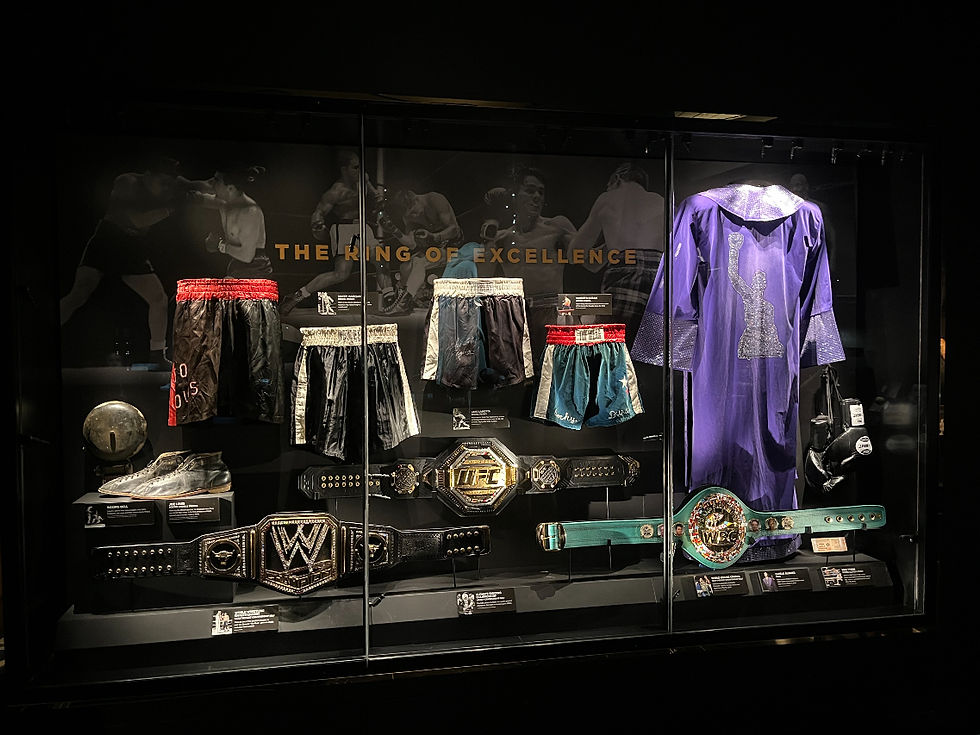
Earlier this year, we wrapped up a project that put a lot of these principles to work: a museum-quality installation at the Fontainebleau Las Vegas.
We got the call because a much larger company had to turn it down. Normally, we handle everything ourselves: fabrication, mount-making, crating, transport, and installation. But since we came in at the last minute, we were coordinating with teams already in place—a designer out of DC, a case company from Germany, and a graphics company from Chicago.
Our role was mount-making and installation for a collection that thousands of visitors would see in a high-end hospitality environment. The timeline was three months from start to finish.
The mounts needed to be secure enough for a commercial environment but elegant enough to disappear visually. They had to accommodate specific dimensions and weight while meeting the aesthetic vision. And everything needed to be installed flawlessly, on schedule, in a space that was still under construction around us.
When it's done right, this kind of work looks effortless. But it takes years of experience and solid technical knowledge to pull off. It's also exactly why clients appreciate working with a full-service team that can handle all these pieces from the start.
Why This Matters
When you work with Denali, you're getting a team that stays plugged into national conversations about best practices. We understand museum-quality standards and bring that expertise to every project—public sculptures, gallery installations, private collections, and commercial spaces.
We're proud to be part of the NEMA community, even as a smaller shop operating primarily in the Gulf South. Good work is good work, regardless of scale or location. Caring about how art is protected, presented, and preserved is something we strive to uphold at Denali.
Thanks to Doug Stark, Amy Hastings, and Camille Breeze for welcoming us into this conversation. We're already looking forward to next year.
Want to know more about how we apply these museum-quality standards to mount-making? Stay tuned for our next post, where we'll dive into the technical side of custom mounts—the materials, the techniques, and the collaboration that makes it all work.
Planning an installation that needs museum-quality expertise? Get in touch. We'd love to talk through your project.
This post is part of our Shop Talk series, where we pull back the curtain on how art fabrication and installation actually work. Want more insights like this delivered to your inbox? Join our mailing list.


Comments